Why Your Horse's Care Team Should Include an Acupressure Practitioner

Every horse deserves a full care team. A veterinarian for diagnosis and treatment. A farrier for hoof balance. A trainer who knows how they move and behave under saddle. Maybe a chiropractor or saddle fitter to catch alignment and fit issues before they become bigger problems. Each professional on that team sees a different piece of the puzzle, and most owners have gotten pretty good at building that team out.
But there's one piece that often gets left out of the conversation entirely: the internal, energetic patterns that show up long before, or completely separate from, a structural or medical issue. It's not that this piece isn't valuable, it's just that most people don't know to look for it, or who to ask.
That's where an acupressure practitioner comes in. Not to replace anyone on the team, but to add a lens nobody else is bringing to the table.
The Team Most Owners Already Have
A veterinarian is the medical backbone of the team. They diagnose and treat disease and injury, run bloodwork and imaging, and are the ones who step in when something needs more than observation, medication, surgery, or a treatment plan grounded in clinical evidence. No other member of the team replaces this role, and none of us should try to.
A farrier keeps the foundation solid. Hoof balance affects everything above it, movement, posture, even how a horse loads weight through its joints and back. A lot of issues that show up higher in the body actually start from the ground up, and a good farrier is often the first to notice subtle changes in gait or stance before anyone else does.

A trainer sees the horse in motion, under saddle, on the lunge line, or working through a session. They pick up on behavior changes, resistance, spookiness, or performance shifts that might not show up standing still in a stall or paddock. A trainer often has the longest, most consistent relationship with a horse's day-to-day temperament, which makes them a valuable early-warning system for anything that feels "off."
A chiropractor or saddle fitter looks at alignment and fit. They catch mechanical compensations, a horse quietly shifting its weight to protect a sore spot, uneven muscle development, or tack that's causing problems long before it turns into a bigger issue. Saddle fit especially is one of those things that seems minor until it isn't, a poor fit can shape behavior, movement, and soundness over time.
Each of these professionals brings something essential, built on years of training and hands-on experience with horses. None of them are in competition with each other, or with what an acupressure practitioner adds. They're all looking at the same horse through a different window, and the horse benefits most when those windows are compared instead of kept separate.
The Bodywork Most Owners Know
Beyond the familiar faces already on a horse's team, there's often another layer: bodyworkers focused on massage, myofascial release, or stretching. These practitioners bring real, hands-on value. They work through muscle tension, addressing tight spots that build up from training, work, or simply how a horse carries itself day to day. They pick up on asymmetry, one side of the body holding differently than the other, and can often trace that back to how a horse is moving, standing, or compensating for something else going on.
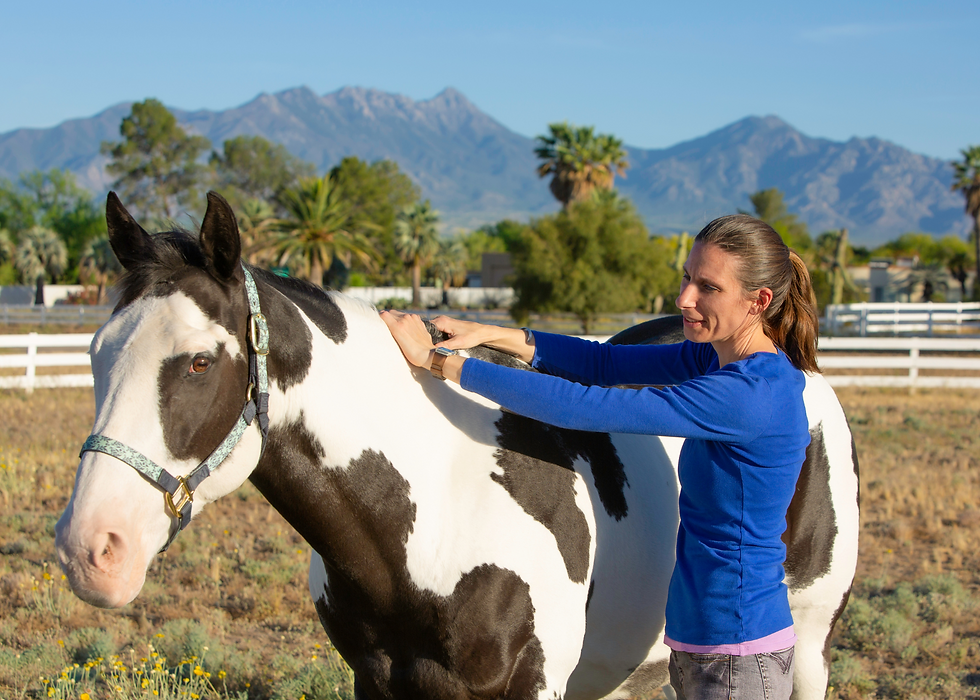
This kind of bodywork also plays a big role in recovery. After hard training, competition, or even just a tough week, muscles hold onto tension the same way ours do. A skilled bodyworker can help release that buildup, improve circulation, and support a horse's ability to bounce back and stay comfortable in their body. Stretching work adds another layer on top of that, improving range of motion and flexibility, which can make a real difference in a horse's overall movement quality and even help prevent future strain.
A lot of this work is also genuinely diagnostic in its own way. A bodyworker's hands can catch things a vet exam might not, subtle tightness, a spot that flinches under light pressure, a pattern of holding that repeats session after session. That kind of information is valuable, and it's often the reason an owner first calls in a bodyworker to begin with, something felt off, and they wanted another set of hands on the problem.
Most of this work, though, centers on structure and movement. How the body is holding tension. Where it's compensating. What's tight versus what's loose, and how that shows up in the way a horse moves under saddle or across the pasture. It's a valuable, physical lens, and one a lot of owners are already familiar with when they think about "bodywork" for their horse.
But structure and movement are only one layer of what's happening inside a horse. There's another conversation going on beneath the muscle, one that doesn't always show up as tension you can feel with your hands.
What an Acupressure Practitioner Adds
Most bodywork conversations start and end with structure and movement, muscle tension, asymmetry, range of motion, recovery from exertion. That's valuable work, and it matters. But it's only part of the story.

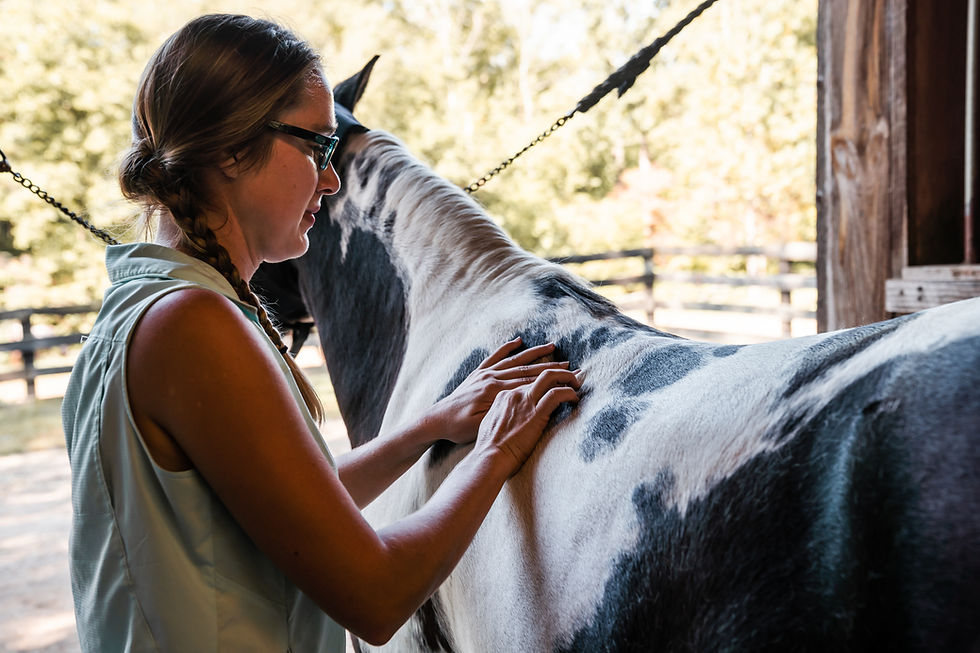
As an acupressure practitioner, my lens is a little different. I'm not just feeling for tension or checking how a horse moves, I'm looking at how a horse's internal systems, digestive, immune, nervous, emotional, are communicating through the body's meridian pathways. In Traditional Chinese Medicine, physical behavior and emotional patterns are deeply connected to specific organ systems and elements. A horse isn't just a collection of muscles and joints, every system inside them is in conversation with the others, and that conversation shows up on the outside if you know where to look.
A horse who suddenly becomes girthy, head shy, or unusually reactive isn't always telling a purely mechanical story. Sometimes that behavior is a window into an internal imbalance that hasn't shown up anywhere else yet, not on a vet exam, not in bloodwork, not to the naked eye. That's not because those tools aren't good, it's because some things surface as a whisper before they surface as a symptom.
This is also where repeated sessions matter. A single vet visit is a snapshot. Sitting with the same horse over time, session after session, means subtle shifts in behavior, responsiveness, and energy become noticeable in a way a one-time check-in often can't capture. You start to know what "normal" looks like for that specific horse, and that makes it a lot easier to notice when something's off.
I get it if this all sounds a little out there, especially if the word "acupressure" makes you think of something more spiritual than practical. But the truth is simpler than it sounds, and you've probably used a version of it on yourself without realizing it. I've written more about the actual mechanism behind it here, including why the same points used in acupuncture are the ones I'm working by hand. If you're the type who wants the "does this actually work" answer before trusting the "here's how I use it" one, start there.
A Quick Look Through the Five Elements
One of the more practical parts of this work is how directly TCM's Five Element Theory maps onto everyday behavior. Each element is tied to specific organ systems and meridians, and a horse's habits, especially the odd or persistent ones, can point to which element might need extra support.

Take a horse that's mouthy or cribbing. That behavior often traces back to the Stomach and Spleen meridians, both part of the Earth element. It doesn't necessarily mean something is wrong with the stomach or spleen themselves, it can simply mean that meridian system needs support, whether that's through diet, routine, stress reduction, or bodywork. Earth governs digestion and also has a strong tie to a horse's sense of groundedness and security, so a horse leaning on oral habits may be telling you something about both.
Or take a horse struggling to sweat properly in the heat of summer. That points to the Fire element needing support. But it's rarely that simple, Fire can also be suppressing the Metal element, which governs the Lung and Large Intestine meridians. Metal is closely tied to skin, so a horse with a sweating issue in summer might also show it show up as dull coat, skin sensitivity, or respiratory tightness, all signs that Metal could use attention alongside Fire.
This is the kind of pattern-reading that sits at the center of acupressure work. It's not about diagnosing an organ problem, it's about noticing which system is asking for support and responding before that imbalance grows into something bigger.
Stories From the Field
Concepts like this are easiest to understand in action, so here are two moments from my own table that show what this looks like in practice.
The Mare Who Wouldn't Let Go
I met a mare during a clinic who'd had a rough previous life. She didn't want to show emotion, likely a survival habit from being sensitive around humans who hadn't yet earned her trust. The class was working Pericardium 6, a point tied to the pericardium's role in protecting the heart and regulating emotional and physical stress responses.
A group of us held that point together for nearly twenty minutes. Then longer. Nothing, no release, no shift. And then, all at once, she started yawning, over and over, followed by licking and chewing, her body's way of finally letting go. Knowing her history and watching that release happen in real time was one of those moments that reminds you why this work matters.
The mare is showing stress and concern. Her release was beautiful and much needed!
The Horse Who "Told" Her Owner First
A client brought me out for her horse's allergies and some general support. During the session, the horse reacted strongly at the stomach meridian, clearly sensitive in that area. I'm not in a position to diagnose, so I told the owner what I was seeing was an imbalance worth mentioning to her vet, nothing more.
What happened next surprised even me. Later that same day, the owner had an animal communicator out, someone I'd had zero contact with, and the communicator relayed that the horse said her stomach hurt. Not long after, that horse had a colic episode, thankfully caught and treated in time by her vet.
I can't tell you what that reaction at the stomach meridian meant medically. But I can tell you it was there before anything else was, and that's the whole point: acupressure won't tell you what's wrong, but it can tell you where to look.
Where the Line Is
Stories like these are powerful, but I want to be clear about what they are and what they aren't. I'm not diagnosing. I never have been, and I never will be, that's not what acupressure is for, and it's not within my scope of practice.
What I can do is notice. A sensitive point, a resistance to touch in a specific area, a behavior that doesn't quite add up, these are signals, not conclusions. When something shows up, my job isn't to name what's wrong. It's to flag it, and to know the difference between "this is something I can support" and "this needs a veterinarian's eyes."
That distinction matters more than almost anything else in this work. It's what makes acupressure a responsible part of a horse's care, not a replacement for one. A vet diagnoses and treats. I observe and support, and I make sure the two stay connected instead of operating in silos.
Loop Everyone In
Your horse's care team is only as strong as the communication between its members. A vet, a farrier, a trainer, a bodyworker, none of us are in competition with each other, and none of us have the full picture alone. We're each contributing a different lens to the same horse, and the horse benefits most when those lenses are compared instead of kept separate.

The next time your horse is due for a check-in with any member of their care team, consider looping in the practitioner who's been watching their patterns all along. Sometimes the earliest signs of something worth flagging show up somewhere nobody thought to look, not in a scan, not in bloodwork, but in a point that wouldn't release until it finally did.
If you've never had an acupressure session for your horse, or it's been a while, that's a good place to start. Book a session or reach out with any questions, I'd love to be one more set of eyes on your horse's wellbeing.
And if you're the kind of owner who wants to build this awareness yourself, to start noticing what your horse's body is telling you between sessions, that's something you can learn too. My Equine Acupressure for Owners course walks you through the foundations, key points, and how to apply them confidently at home. You don't need a background in bodywork, just a willingness to pay closer attention.