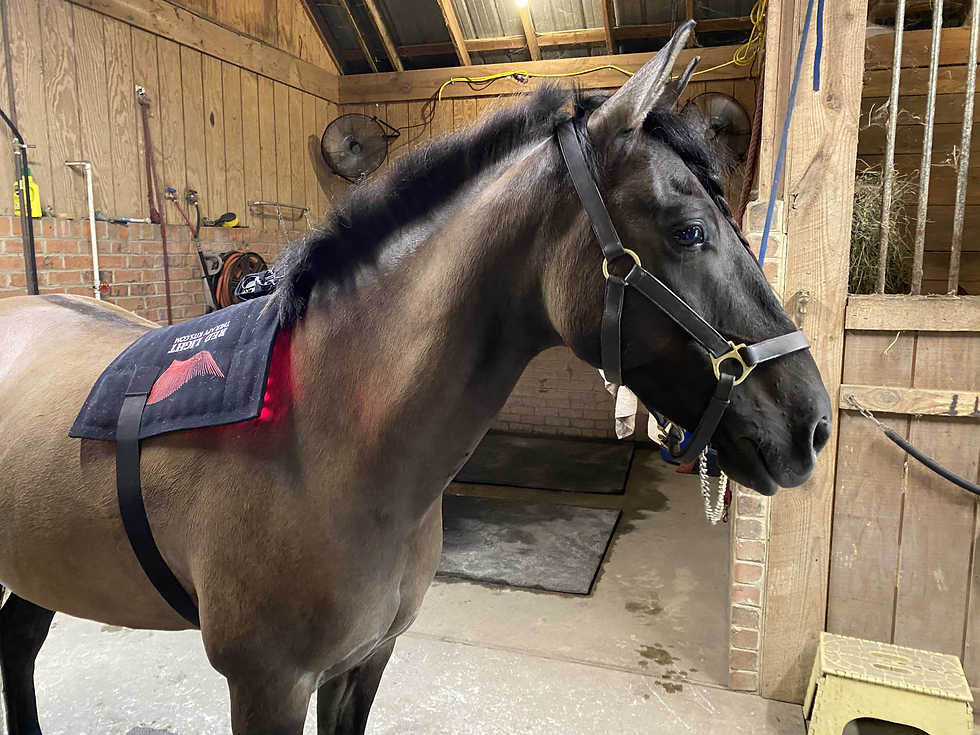
How Red Light Therapy and PEMF Use Electromagnetic Energy to Heal Your Horse

When most people think about Red Light Therapy and PEMF, they think of two very different tools sitting in very different categories. One uses light. One uses magnets. They look and feel different. But here's something that might surprise you: at their core, both therapies are made of the exact same thing: electromagnetic energy.
That's not a metaphor. Red light therapy and PEMF both operate on the electromagnetic spectrum, the same spectrum that includes radio waves, microwaves, and the sunlight your horse basks in every morning. What makes them different isn't what they are — it's where they sit on that spectrum, and how your horse's body responds to each one. Understanding this changes everything about how you choose and use these therapies.
If you're looking for a comprehensive overview of how red light therapy and PEMF work and the conditions they may support, check out our Red Light Therapy vs. PEMF for Horses guide. But if you want to understand the why behind both therapies — keep reading. So let's start at the very beginning, with energy itself.
Everything Is Energy: The Electromagnetic Spectrum
The electromagnetic spectrum is essentially a map of all the different forms of energy that travel as waves through space. From radio waves on one end to gamma rays on the other, every single one of them is made of oscillating electric and magnetic fields moving together. What separates them isn't their ingredients, it's their frequency, meaning how fast those waves are vibrating.
Think of it like sound. A low rumble and a high-pitched whistle are both sound waves, but they vibrate at completely different speeds and your body experiences them very differently. Electromagnetic energy works the same way.
Here's where it gets interesting for your horse's health. Both red light therapy and PEMF sit on this same spectrum — but at completely opposite ends of it. Red and near-infrared light vibrate at an incredibly fast frequency, while PEMF pulses at an extremely slow one. And that difference in frequency is exactly what determines how each therapy enters the body, how deep it reaches, and what it tells the cells to do.

Your horse's body is not just flesh and bone, it is electrically alive. Every heartbeat, every nerve signal, every cellular process runs on electrical and chemical energy. So it makes sense that therapies working with electromagnetic energy would have such a profound effect on healing and recovery.
Why does this matter for your horse specifically?
Because it means that when you choose between red light therapy and PEMF, or use them together, you aren't choosing between two random wellness tools. You are choosing between two very precise frequencies of energy, each with a unique ability to communicate with your horse's cells and support their natural healing processes. Understanding that distinction helps you make smarter, more intentional decisions about your horse's care.
Where Red Light Lives on the Spectrum (And Why Photons Matter)
Red and near-infrared light sit in the higher frequency range of the electromagnetic spectrum, with wavelengths between roughly 600 and 1000 nanometers. At these frequencies, something unique happens: the energy begins to behave in discrete little packets called photons.

You've probably heard the word photon before, but what does it actually mean for your horse? A photon is essentially a tiny bundle of light energy. And at red and near-infrared wavelengths, those photons carry just the right amount of energy to be directly absorbed by cells.
Inside your horse's cells are structures called mitochondria, often called the powerhouse of the cell because they produce ATP, which is the energy currency the body runs on. Within the mitochondria lives a molecule called cytochrome c oxidase, and it has a remarkable ability: it can absorb red and near-infrared photons like a solar panel absorbing sunlight.
When that absorption happens, mitochondria are stimulated to produce more ATP. Think of ATP like fuel in your horse's gas tank. A healthy, well-rested horse has a full tank. But an injured, inflamed, or overworked horse is running on empty and their cells simply don't have enough fuel to repair themselves efficiently. Red light therapy essentially pulls up to the pump. The photons absorbed by cytochrome c oxidase trigger the mitochondria to produce more ATP, refueling the cells so they can get back to the critical work of healing.
A great example of this in action is a horse with a tendon injury. Tendons are notoriously slow healers because they have poor blood supply and limited cellular energy to draw from. When red and near-infrared light is applied to the injured area, photons penetrate into the tissue and are absorbed at the cellular level. The mitochondria respond by ramping up ATP production, giving those tendon cells the fuel they desperately need to repair damaged fibers, reduce inflammation, and rebuild healthy tissue faster than they could on their own.
This is why red light therapy works beautifully on muscles, wounds, joints, tendons, and skin — tissues where light can penetrate and photons can be put to work directly at the cellular level.
Where PEMF Lives on the Spectrum (And Why It Works Differently)
If red light therapy operates at the fast, high-frequency end of the electromagnetic spectrum, PEMF sits at the complete opposite end — in the realm of extremely low frequencies, typically pulsing anywhere from 1 to 100 times per second. To put that in perspective, red light vibrates hundreds of trillions of times per second. PEMF pulses just a handful of times per second. They are on the same spectrum, but they are worlds apart in terms of frequency.

At these ultra-low frequencies, electromagnetic energy does not behave like photons at all. There are no little packets of light being absorbed by cellular receptors. Instead, what PEMF produces is a slow, pulsing magnetic field that passes directly through the body — through skin, muscle, and even bone — without needing to be absorbed the way light does.
Here is where the magic happens. As that pulsing magnetic field moves through your horse's tissues, it induces tiny electrical micro-currents within the cells it passes through. This is the same basic principle as electromagnetic induction — the same science behind how a generator produces electricity. The moving magnetic field essentially nudges electrons in the tissue, creating a gentle electrical signal that the cells respond to.
And respond they do. Those micro-currents influence the cell membrane's electrical charge, improving how ions like calcium, potassium, and sodium move in and out of the cell. This restored cellular charge is like hitting a reset button — it wakes up sluggish, damaged, or inflamed cells and encourages them to function properly again. Improved ion exchange means better circulation, reduced inflammation, accelerated tissue repair, and enhanced nerve function.
This is why PEMF is particularly powerful for deeper issues, things like arthritis, bone healing, chronic pain, and neurological challenges. Because it doesn't rely on photon absorption, it isn't limited by how deep light can penetrate. The magnetic field passes through everything, reaching tissues that red light simply cannot access on its own.
Think of it this way: red light therapy speaks directly to the cell's energy factory through photons and PEMF sends an electrical signal through the cell's walls and resets how it communicates with the rest of the body. Same electromagnetic family, completely different conversation.
Not All PEMF Is Created Equal: Why Training and Device Type Matter
If you've ever watched a PEMF session on a horse, you've likely noticed something striking: the muscles visibly twitch and contract with each pulse. It can look intense, and it raises a completely valid question: is all of that muscle stimulation actually good for the horse, or could it cause fatigue?
The honest answer is that it depends entirely on who is operating the device and what device they're using.
A trained PEMF practitioner, such as a certified MagnaWave or Pulse practitioner, is doing far more than simply placing loops on a horse and turning on a machine. They are actively watching the tissue response in real time with every single pulse. They are reading how the muscles are contracting, assessing whether an area is over-responding, adjusting the intensity and duration accordingly, and making informed decisions about placement based on what the horse's body is telling them in that moment. That is a clinical skill set developed through proper training and hands-on experience.
The muscle contractions you see during a professional PEMF session are not the same as a muscle fatiguing during a marathon. During exercise, the muscle is actively burning through its own fuel reserves: depleting ATP, consuming oxygen, and generating lactic acid. That is what creates genuine fatigue. With properly administered PEMF, the contraction is a passive neurological response triggered externally, while the therapy simultaneously encourages the cells to produce more ATP. The muscle is being stimulated, not exhausted — as long as the settings and duration are appropriate for that horse.
This is where consumer PEMF blankets like the Bemer raise legitimate concerns. When a blanket is draped over a horse and switched on, the entire body is being exposed to electromagnetic pulses simultaneously and nobody can see what is happening underneath. There is no visual feedback on tissue response. There is no ability to identify if a specific area is over-stimulated, if the intensity is too high for a sensitive region, or if the horse's body is responding appropriately. The settings are often generalized rather than tailored to the individual horse's needs that day.
Compare that to a trained practitioner using handheld loops or applicators, who can see exactly how each area of the horse's body is responding, adjust in real time, and ensure the therapy is working with the horse rather than just on the horse. That distinction matters enormously especially for horses with acute injuries, neurological sensitivities, or complex conditions.
PEMF is a powerful therapeutic tool. But like any powerful tool, its safety and effectiveness depend heavily on the knowledge and skill of the person using it.
The Equine Application: Which Energy Does Your Horse Need?
Understanding the science is one thing, but what does it actually look like in practice for your horse? The good news is that once you understand how each therapy works, choosing between them becomes much more intuitive. It's less about picking a winner and more about matching the right electromagnetic tool to what your horse's body needs most in that moment.
The Performance Horse

For horses in regular work, whether that's barrel racing, jumping, dressage, or trail riding, the body is constantly being pushed and recovering. Red light therapy is an excellent tool for these horses because of its ability to accelerate muscle recovery, reduce inflammation in soft tissues, and support joint health through increased collagen production. Applying red and near-infrared light after a hard workout or competition helps refuel those energy-depleted cells quickly, getting your horse back to peak condition faster.
PEMF is equally valuable for the performance horse, particularly for maintaining deep tissue health, supporting bone density, and addressing any lingering areas of chronic tension or soreness that red light alone may not fully reach. Many performance horse owners and trainers use both therapies as part of a regular maintenance protocol, not just for recovery, but for prevention.
The Injured Horse
When a horse is dealing with a specific injury, a tendon strain, a suspensory issue, muscle damage, or a wound, red light therapy's ability to deliver photons directly to damaged tissue makes it an incredibly precise healing tool. It works beautifully in the early to mid stages of injury recovery, supporting cellular repair right where it's needed. If you're dealing with a lame horse, our Detailed Guide on Equine Lameness is a great resource for understanding the causes and holistic approaches to recovery.
PEMF can be a powerful complement during injury recovery as well, particularly for reaching deeper structures or addressing the broader systemic inflammation that often surrounds an injury site. However, as discussed earlier, this is where working with a trained practitioner matters most: the intensity, placement, and duration of PEMF need to be carefully tailored to the stage of healing and the specific nature of the injury.
The Senior or Arthritic Horse
For older horses managing the chronic discomfort of arthritis, stiffness, or degenerative joint conditions, both therapies offer meaningful relief, but in different ways. Red light therapy supports collagen production within the joints and helps manage localized inflammation and pain on an ongoing basis. PEMF's deep-reaching electromagnetic pulses are particularly effective for resetting the cellular environment around chronically inflamed joints, improving circulation, and supporting nerve function that may be affected by long-term joint degeneration.
Together, these two therapies offer senior horses a genuinely comprehensive approach to comfort and mobility, addressing both the surface-level tissue health and the deeper systemic cellular environment that determines how well an aging body can continue to heal itself.
The Healthy Horse
It's worth saying clearly — you don't have to wait for an injury or diagnosis to benefit from either therapy. Both red light therapy and PEMF are excellent tools for maintaining the health and resilience of horses that are currently feeling their best. Regular sessions support immune function, improve circulation, keep soft tissues supple, and help the body stay ahead of the wear and tear that comes with an active life. Prevention is always more powerful than recovery.
Why Using Both Red Light Therapy and PEMF Makes Sense
By now it's clear that red light therapy and PEMF are not interchangeable — they work through genuinely different mechanisms at different depths and frequencies. But that difference is precisely what makes them such a powerful combination when used together.

Because they operate through distinct pathways, there is no redundancy in using both. Red light therapy is delivering photons to the surface and mid-level tissues, directly fueling cellular energy production through mitochondrial absorption. At the same time, PEMF is sending pulsing electromagnetic fields deep into the body, resetting cellular charge and restoring healthy communication across tissues that light cannot fully reach on its own. They are not doing the same job twice, they are filling in each other's gaps.
Think of your horse's body as a multilayered system that needs support at every level. Red light therapy is addressing the cellular energy layer making sure individual cells have the fuel they need to repair and regenerate. PEMF is addressing the electromagnetic communication layer making sure cells are receiving and sending the right signals to coordinate healing across the whole system. Together they create a truly comprehensive therapeutic environment that neither could achieve alone.
This combination is particularly valuable in the following situations:
Post-competition recovery — Red light accelerates muscle repair and reduces surface inflammation while PEMF restores deep tissue circulation and resets any areas of tension or nerve fatigue from the effort of competition.
Injury rehabilitation — Red light supports localized tissue repair at the injury site while PEMF addresses the broader inflammatory response and promotes healing in the deeper structures surrounding the injury.
Chronic condition management — For horses dealing with ongoing issues like arthritis or recurring soreness, the layered approach of both therapies working together provides more consistent and lasting relief than rotating between them separately.
General maintenance and prevention — Regular sessions combining both therapies keep the entire electromagnetic environment of your horse's body functioning optimally from the cellular energy level all the way through to deep tissue and systemic health.
For horse owners looking to incorporate red light therapy into their horse's wellness routine, Poll to Pastern specializes in red light therapy and offers several product options designed with ease of use in mind. Our devices feature built-in 20 minute timers so you never have to guess how long to apply to each area — the therapy is optimized and delivered consistently every single session. Whether you're targeting a specific injury site, a joint, or incorporating red light into a broader maintenance routine alongside PEMF, having a reliable and simple-to-use device makes all the difference in staying consistent with your horse's care.
The bottom line is simple. Red light therapy and PEMF both speak your horse's electromagnetic language. Using them together means your horse is getting the full conversation — and that is when the most profound healing happens. To learn more about how red light therapy and PEMF fit into a broader holistic approach, check out our guide to Complementary Therapies for Equines.
Your Horse Deserves the Full Conversation
The electromagnetic spectrum is vast, and somewhere within it lies the precise energy your horse's body needs to heal, recover, and thrive. Red light therapy and PEMF are not mysterious wellness trends, they are scientifically grounded tools that work with the body's own electromagnetic nature, each speaking a different dialect of the same healing language.
Whether your horse is a seasoned competitor pushing their limits, a senior horse managing the discomforts of age, or a healthy horse you simply want to keep that way — understanding how these therapies work at a fundamental level empowers you to make smarter, more intentional decisions about their care. And that knowledge, combined with the right tools and the right practitioners, is what separates good horse care from truly exceptional horse care.
If you're ready to explore red light therapy for your horse, we invite you to browse our range of red light therapy products at Poll to Pastern. From our EquineGlow Poll to our AcuGlow Torch, each product is designed with your horse's healing in mind — simple to use, precisely timed, and built around the science that makes red light therapy so effective. And if you have questions about which product is right for your horse or want to book a session, we'd love to hear from you.
Your horse's healing journey starts with the right energy. Let's find it together.