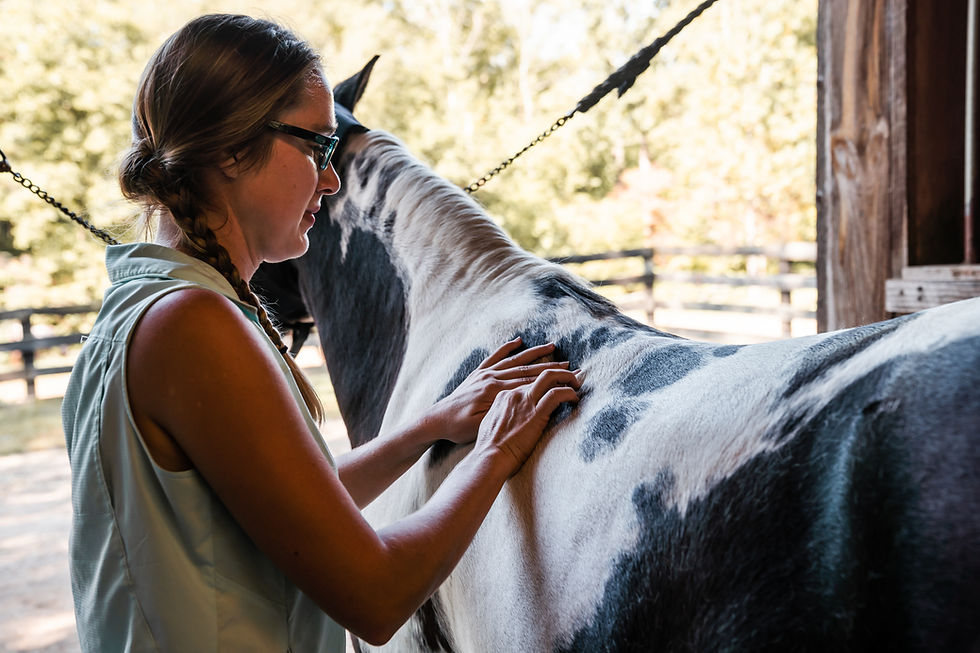
5 Essential Acupressure Points Every Horse Owner Should Master

You know your horse. You know the way he meets you at the gate, the way he carries himself across the paddock, the look in his eye when he's feeling good. So when something's just a little off, nothing you need to call the vet about, but you can quite put your finger on, you notice. He's a little dull today. Moving a bit stiffly. Not quite himself.
Those are the moments that make you wish you had one more way to show up for him.
That's exactly why acupressure is great knowledge for horse owners. Not as a fix, not as a replacement for veterinary care, but as a way to offer something genuinely supportive on the days your horse needs a little extra. A way to use your hands with intention, stay connected to what's happening in his body, and give back some of what he gives you every day.
Acupressure is one of the oldest forms of healing in the world, rooted in Traditional Chinese Medicine and used on horses for centuries. It works by applying gentle, focused pressure to specific points along the body's meridian pathways — channels where energy (called Chi, pronounced "chee") flows. When that flow becomes blocked or imbalanced, the body struggles. When you restore it, you support the body's own ability to heal, regulate, and recover.
The best part? You don't need any equipment. Just your hands, your presence, and the knowledge of where to press.
In this guide, I'm going to walk you through 5 of the most essential acupressure points every horse owner should have in their toolkit. These are the points I teach in my Equine Acupressure Certification Course, because they're tools for the Tuesday afternoons, the pre-ride routines, the seasonal check-ins, the quiet moments in the barn when you want to do something good for your horse.
That said, a quick note before we begin: Acupressure is a complement to veterinary care, never a replacement. If your horse is showing signs of illness, acute pain, or anything that concerns you, your vet is always the first call. Some of these points may offer comfort in acute situations, but only ever alongside professional veterinary involvement, and only if your vet is on board.
With that in place — let's get into the points.
Before You Begin: How to Apply Acupressure Correctly

Before we dive into the points themselves, a quick word on technique because how you press matters just as much as where you press.
Use the right pressure: Acupressure is not massage. You're not rubbing or kneading — you're applying steady, direct pressure to a specific point. Start light (about the weight of a coin resting on the skin) and gradually increase until you feel gentle resistance. Think "firm but kind."
Use your thumb or two fingers: For most equine points, you'll use the flat pad of your index and middle fingers held together. Keep your wrist relaxed and let your body weight do the work rather than straining your hand.
Hold for 30–90 seconds: Acupressure isn't a quick tap. Hold the point steadily and watch your horse's response. Many horses will exhale slowly, lower their head, lick and chew, or visibly soften through the body, these are all signs the point is releasing.
Work both sides: Most points exist bilaterally (on both the left and right side of the body). Always work both sides for a balanced effect.
Read your horse: If your horse moves away, pins his ears, or seems more agitated when you touch a point, back off. Sensitivity can indicate tension or discomfort in that area, don't force points they are not comfortable with.
When NOT to use acupressure:
Over open wounds, infections, or areas of active inflammation
Directly over a fracture or serious injury
On a horse in acute, severe distress without simultaneous veterinary involvement
During the first and last trimester of pregnancy (certain points are contraindicated)
As a substitute for emergency veterinary care — always call your vet first!!!
Want a visual reference while you learn? I've put together an Equine Acupressure Point Charts — a detailed digital resource showing over 200 points across full front and back body diagrams. It's something you can pull up on your phone in the barn, print and hang in your tack room, or use alongside this guide as you practice. If you're a visual learner or just want everything in one place, it's a great companion to have.
Point 1: The Digestive Support Point (ST-36)
Stomach 36 is one of the most well-researched and widely used acupressure points in both human and equine practice. It's a foundational point for digestive health, supporting healthy gut motility, reducing inflammation along the digestive tract, and promoting overall vitality and immune function.
In everyday practice, this is a point worth incorporating into your regular routine — especially for horses who are prone to digestive sensitivity, going through feed changes, in heavy work, traveling frequently, or dealing with seasonal stress. A horse whose gut is balanced is a horse who absorbs nutrients well, recovers faster, and stays more emotionally even.
Because of its strong connection to the digestive system, ST-36 is also a point some practitioners use to provide comfort during episodes of mild digestive upset, but this is always secondary to veterinary care. If your horse is showing signs of colic, call your vet immediately. If your vet is aware and on the way, and you want something supportive to do with your hands in the meantime, this is the point and only with your vet's knowledge.

Where to find it:
ST-36 is located on the hind leg, just below the stifle joint on the outside of the leg. Here's how to find it:
Stand at your horse's hip, facing toward his head.
Place the palm of your hand on the stifle with fingers facing downward.
Twist your fingers slightly towards you and you should feel the little dip in the tibia.
Press gently and watch for a release while you hold the point: licking, yawning, chewing, etc.
(In a full course setting, I provide anatomical diagrams and video walkthroughs — finding points becomes second nature very quickly with practice.)
What to expect:
ST-36 isn't a cure for colic — your vet is still coming, and that's non-negotiable. But horses often visibly relax during and after stimulation of this point. Gut sounds may improve. The horse may stop pawing or circling as intensely. You are supporting the body's own regulatory response while help is on the way.
Important note: ST-36 is contraindicated during pregnancy — it's a powerful point that can stimulate uterine activity. Skip this point on mares who are pregnant or potentially pregnant.
Remember: If your horse's colic symptoms are severe, worsening, or don't respond to walking and basic care, this is a veterinary emergency. Call first, apply acupressure second.
Want to keep reading? The next four points cover calming for trailering, general pain relief, energy support, and seasonal immune health — each one building your confidence and your horse's trust in your hands.
Point 2: The Calming Point (GV-14)
Every horse owner knows that horse. The one who loads fine at home but arrives at the show drenched in sweat. The one who trembles at the vet clinic. The one who turns a routine farrier visit into a rodeo. Anxiety in horses isn't stubbornness — it's a nervous system that's firing on high, and Governing Vessel 14 (GV-14) is one of the most effective points for bringing it back down.
What makes this point especially fascinating is that horses already know it. Watch any two bonded horses in a field and you'll see them gravitate to this exact spot, mutual grooming at the base of the neck and withers is one of the primary ways horses calm each other and reinforce their bond within the herd. It's an instinctive, hardwired behavior. When you apply acupressure here, you're not doing something foreign to your horse, you're speaking a language he already understands.
GV-14 sits along the Governing Vessel meridian, which runs along the topline of the horse from tail to upper lip. This meridian governs the entire yang energy of the body, think of it as the body's central "on/off switch" for activation and stress response. Stimulating GV-14 has a direct calming effect on the nervous system and is particularly useful before and during high-stress situations.
Where to find it:

GV-14 is located at the base of the neck, right where the neck meets the back, in front of the prominent bony bump you can feel at the withers, where the last cervical vertebra meets the first thoracic vertebra.
Stand alongside your horse at the shoulder.
Run your hand up the shoulder toward the withers.
Feel for the tallest point of the withers area and slide your fingers forward.
The point sits in the depression just in front of that bony prominence, right at the midline.
Pro tip: Apply this point 10–15 minutes before a stressful event — before loading the trailer, before the vet arrives, before you tack up for a big competition. Acupressure is most effective as a preventative tool, not just a reactive one.
What to expect:
You won't sedate your horse. What you will see is a horse that's more available — more able to think, listen, and respond rather than react. The edge comes off. That's the goal.
Point 3: The Pain Relief Point (BL-60)
Horses can't tell you where it hurts. They show you: in a short stride, a pinned ear when you reach for the girth, a reluctance to pick up one lead. When you notice your horse is uncomfortable but you're waiting for a vet appointment, or you want to support recovery after a hard workout, Bladder 60 (BL-60) is your go-to point.
Known in Traditional Chinese Medicine as Kunlun, named after a sacred mountain, BL-60 is often called the "aspirin point" for good reason. It's one of the most powerful analgesic (pain-relieving) points in the entire meridian system. It works across the whole body, making it useful for generalized soreness rather than a specific location.
Where to find it:

BL-60 is located on the hind leg, in the depression between the point of the hock and the Achilles tendon, essentially in the "hollow" on the outside of the hock.
Face your horse's hindquarters and crouch down at the hind leg.
Locate the point of the hock — the bony prominence that sticks out to the rear.
Slide your fingers to the outside of that prominence, between the bone and the large tendon running behind it.
You'll feel a distinct soft depression — that's BL-60.
Important note: BL-60 is contraindicated during pregnancy — it's a powerful point that can stimulate uterine activity. Skip this point on mares who are pregnant or potentially pregnant.
What to expect:
Relief isn't always immediate, but many owners report that horses worked with BL-60 seem freer in their movement afterward, more willing to track up, more even in both directions, less reactive to touch along the topline or hindquarters. Think of it as taking the edge off while the body continues to do its own healing work.
Point 4: The Energy Boost Point (BL-23)
You know the feeling — your horse drags out of the stall, isn't interested in his feed, feels flat under saddle, and just seems... dimmed. Sometimes it's seasonal. Sometimes it's after a long competition stretch. Sometimes it's a horse who's been stall-rested and has lost his spark. Bladder 23 (BL-23) is the point to reach for when your horse needs a gentle recharge.
BL-23 is the association point for the Kidney meridian, which in Traditional Chinese Medicine governs the body's foundational energy reserves — called Jing, or essence. When Kidney energy is low, the whole system feels depleted. Stimulating BL-23 directly tonifies that reserve, helping restore vitality, motivation, and physical resilience.
Where to find it:
BL-23 is located along the Bladder meridian, which runs in a line roughly 3 finger-widths off the midline on either side of the spine. The point sits in the lumbar region, the area of the back just behind the last rib, above the hip.
Stand alongside your horse's barrel, facing his back.
Find the last rib and trace it up toward the spine.
Move your fingers just behind the last rib, about 3 finger-widths off the center of the spine.
Press gently. A horse with depleted Kidney energy often shows sensitivity here, and may dip or "dapple" (ripple the skin) when you touch the area.
What to expect:
This isn't a point that produces dramatic instant results, energy restoration is a slower process. But horses worked regularly on BL-23 often show improvement over several sessions: better coat quality, more eagerness at feeding time, increased engagement under saddle, and a general brightening of demeanor. Think of it as a long game point, steady investment, real return.
Point 5: The Immune Support Point (LI-4)
As the seasons change, horses, like people, can become more vulnerable. You notice it in the barn every spring and fall: horses who seem to catch every respiratory bug that goes around, horses who take longer to bounce back from minor illnesses, horses who struggle with seasonal allergies or inflammatory flare-ups. Large Intestine 4 (LI-4), known as Hegu ("Joining Valley"), is one of the most celebrated immune-supporting points in all of Traditional Chinese Medicine.
LI-4 stimulates the Large Intestine meridian, which governs not just digestion but also the body's wei chi: the defensive energy that acts as the immune system's first line of protection. Regular stimulation of this point helps strengthen that shield, reduce systemic inflammation, and support the body's ability to fight off pathogens and recover from illness.
Where to find it:

In horses, LI-4 is found on the inside of the foreleg, just below the knee along the medial splint bone, that slender bone that runs alongside the cannon bone on the inner face of the leg. Run your fingers down the inside of the foreleg from the knee and you'll feel it as a slight ridge before it tapers away toward the mid-cannon. The point sits right alongs it, in the soft tissue between the two bones.
One thing worth knowing: in older horses, the splint bone gradually fuses to the cannon bone over time, which can make that ridge harder to distinguish by feel alone. Don't let that throw you off, the point is still right there in the same location, and your fingers will find the right spot with a little practice.
If you want an easy way to remember it, think of your own hand. LI-4 is the same point humans use between the thumb and forefinger, that fleshy web of tissue you press when you have a headache. Same meridian, same logic, different body. Once you know it on yourself, you'll recognize the energy of it on your horse.
Stand at your horse's shoulder facing his front leg.
Run your hand down the inside of the foreleg to the knee area.
Just below and slightly behind the inside of the knee, feel for the soft depression of tissue between the bones.
Press gently — this area is often surprisingly sensitive in horses who are dealing with immune or respiratory stress.
Note: LI-4 is contraindicated during pregnancy. It has a strong descending and moving energy that should be avoided in pregnant mares.
What to expect:
Over time and with regular use, many owners report that horses worked consistently on LI-4 show fewer seasonal health hiccups, recover more quickly when they do get sick, and seem generally more robust through difficult weather transitions. It's one of the great maintenance points, the kind that pays dividends when you use it before there's a problem.
What to Expect After a Full Session
If you've just worked all five points for the first time, here's what a normal response looks like:

During the session: your horse may yawn, lick and chew, lower his head, exhale slowly, shift weight, or even show brief emotional release (a little pawing or head tossing before settling). All of this is normal and positive — it means the points are working.
In the hours after: some horses become temporarily more tired than usual. This is called a healing response and is completely normal. Let your horse rest, ensure fresh water is available, and avoid hard work for the remainder of the day.
Over multiple sessions: you'll begin to notice cumulative effects: improved movement, better mood, quicker recovery, more willingness. Acupressure builds, the more consistently you use it, the more your horse's body learns to respond.
Keep a simple journal, just a few notes after each session. What points did you work? How did your horse respond? What did you notice in the following days? Over time, this becomes an invaluable record of your horse's patterns and needs.
These 5 Points Are Just the Beginning
You've just learned five of the most powerful acupressure tools available to horse owners and if you've practiced even one of them, you've already done something most horse owners never will: you've used your own hands to actively support your horse's health.
But five points only scratch the surface.
In our Equine Acupressure Courses, you'll learn:

Acupressure points across all major meridians, with precise location guides, video demonstrations, and printable reference charts
Full-body protocols for common conditions: spooking, digestion, allergies, and more
Five Element Theory the foundational framework of TCM that allows you to assess your horse's constitutional type and understand the root cause of imbalances, not just the symptoms
How to build customized sessions tailored to your individual horse's needs, history, and health goals
Business foundations if you want to offer acupressure professionally to other horse owners, our professional level courses is where you start!
These courses are designed for horse owners and practitioners alike. No medical background required — just a horse you love and a desire to learn. You already have the hands for this. Now get the knowledge to go with them. Whether you're caring for your own horses or building a professional practice, there's a path for you:
This work changed the way I see and feel every horse I work with. I hope it does the same for you.